





Emma Smith
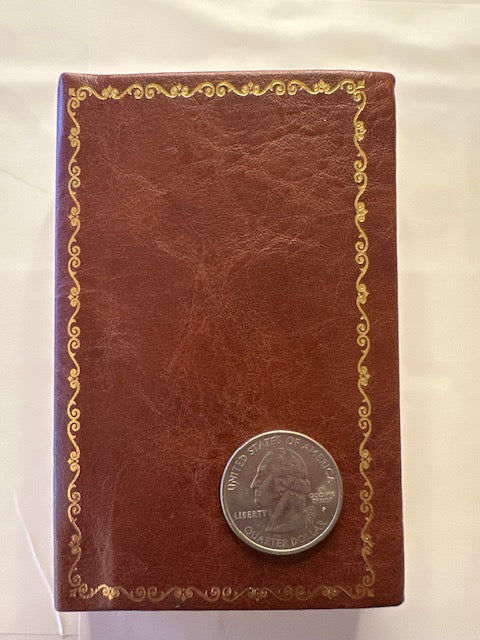
1835 Replica Sacred Hymns Selected by Emma Smith
Hymns of Zion 1835
Couldn't load pickup availability
Share
About the book
We are sorry to report that our China-based printer has just notifed us that due to "government restirctions on the production and distribution of religious materials," they can no longer supply us with these beautiful replica books.
Pray for the people of China that they can be free and offer up your gratitude that we (most of us) still live in countries where we can worship according to the dictates of our own consciences.
We are busy looking for another supplier but for now, our supply of the 1833 Book of Commandments is completely depleted and we have zero in stock. We have a very few 1835 Emma Smith Hymnals remaining in stock. So this is a heads-up that we will soon be OOS (Out of Stock) for some weeks to months on these titles. Thank you for understanding and patience.
========ORIGINAL AD COPY===============
A collection of sacred hymns for the Church of the Latter-day Saints, selected by Emma Smith in Kirtland, Ohio, 1835.
Scanned from a rare 1835 original with special attention paid to reproduce the gold cover tooling. Note: These are very small books, and are ACTUAL SIZE, just the way they were in 1835.
This book is beautifully bound in a leatherette cover with gold embossing on the cover and spine. It matches the binding found on the 1833 Replica Book of Commandments.
"And it shall be given thee, also, to make a selection of sacred hymns. . . . For my soul delighteth in the song of the heart; yea, the song of the righteous is a prayer unto me."—Book of Commandments, Chapter 26
Details
- 3" x 4.5" (authentic actual size of 1835 original)
- Leatherette bound
- Gold embossed
- Square corners
- Colorful, marbled end-sheet design was actually selected by Emma Smith
Interesting Note:
⭐ Emma Smith’s 1835 Hymnal: What It Was
Emma Smith’s 1835 hymnal—formally titled “A Collection of Sacred Hymns, for the Church of the Latter Day Saints”—was:
-
The first official hymnal of the Church
-
Compiled by Emma Smith, as commanded in Doctrine & Covenants 25
-
Printed in Kirtland, Ohio, by F.G. Williams & Co.
-
A small pocket-sized book, roughly 3 × 4.5 inches
-
Contained 90 hymn texts (no musical notation whatsoever)
The hymnal was designed to fit comfortably in the hand or pocket, making it easy to carry to homes, meetings, and outdoor gatherings.
⭐ No Music, Only Lyrics
Because the a cappella, community-singing tradition of the 1830s was well established, Emma did not need to print music. The Saints already knew dozens of standard “psalm tunes” used by Christian congregations in America and Britain.
When you opened the 1835 hymnal, you saw:
-
Only the words (verses of hymns)
-
No tune names
-
No musical staff
-
No suggested melodies
So how did they know what melody to sing?
⭐ Metrical Singing: How It Worked
The key is the metrical system inherited from the English hymn and psalm tradition. Every hymn text has a meter, which describes the pattern of stressed and unstressed syllables.
Emma’s hymnal used the same system as Isaac Watts and other Protestant hymnals.
The primary hymn meters were:
| Abbreviation | Name | Syllable Pattern | Example |
|---|---|---|---|
| LM | Long Meter | 8.8.8.8 | “When I Survey the Wondrous Cross” |
| CM | Common Meter | 8.6.8.6 | “Amazing Grace” |
| SM | Short Meter | 6.6.8.6 | “Blest Be the Tie That Binds” |
| PM | Particular Meter | Irregular; any unique form | “A Poor Wayfaring Man of Grief” (sometimes) |
Any hymn text could be sung to any tune that shared the same meter.
So if a hymn in Emma’s book was labeled (or easily recognized as) LM, it could be sung to any LM tune the congregation knew.
This was extremely useful for frontier Saints who did not always have instruments, trained musicians, or printed music.
Example:
If you had a hymn in Long Meter (8.8.8.8), you could sing it to:
-
Old Hundredth (“Praise God from whom all blessings flow”)
-
Rockingham
-
Windham
-
Hamburg
All were familiar LM tunes.
Likewise, a Common Meter hymn (8.6.8.6) could be sung to:
-
“Amazing Grace”
-
“O For a Thousand Tongues to Sing”
-
“O God, Our Help in Ages Past”
⭐ How the Saints Chose the Tune
Typical pattern in a Kirtland or early Nauvoo meeting:
-
The conductor or speaker announced the hymn number or title.
-
Someone—often the leader, sometimes the congregation—suggested:
“Let’s sing it to the tune of Old Hundredth.”
-
The group instantly recognized the melody, because it was widely known.
-
The congregation sang the hymn’s words from Emma's book,
fitted to the melody they already knew.
This meant that:
-
The same text could be sung to multiple different tunes, depending on preference.
-
Different branches of the Church might use different tunes for the same hymn.
-
Musical variation was normal and expected.
⭐ Why Metrical Singing Was So Important
Because:
-
Most households owned a Bible and a psalmbook.
-
Very few had printed music.
-
Early Saints came from hymn-singing Protestant backgrounds.
-
Traveling missionaries used standard European/American hymn tunes.
Emma’s hymnal fit directly into this world: text first, tune flexible.
It enabled the Saints to sing in:
-
log homes
-
outdoor gatherings
-
temples under construction
-
missionary journeys
-
small branches without instruments
All with a simple, shared system.
⭐ What About PM (Particular Meter)?
“PM” meant the hymn text had an irregular or unique meter that did not fit common 6s and 8s patterns.
For these hymns:
-
You often needed a special tune, already known.
-
Or a “lining out” leader would sing a line, and the congregation repeated it.
-
Sometimes the tune was improvised or borrowed from folk melodies.
This was very common in Primitive Baptist, Methodist, and early LDS worship.
About the author
Our authors challenge conventional wisdom and go beyond the surface to deliver inspiring, faith-affirming, and ultimately transformative content.
Shipping
All orders are processed within 3 to 5 business days (excluding weekends and holidays) after receiving your order confirmation email. You will receive another notification when your order has shipped.
Domestic Shipping Rates and Estimates
Shipping charges for your order will be calculated and displayed at checkout. For a limited time, all domestic orders that contain two (2) or more items will enjoy FREEE SHIPPING.
International Shipping
We offer international shipping to countries where allowed. Any shipping charges will be displayed at checkout.
Returns
We accept returns up to 30 days after delivery if the item is unused and in its original condition. Please review our refund policy for more information.
In the event that your order arrives damaged in any way, please email us as soon as possible at info@digitalegend.com with your order number and a photo of the item’s condition. We address these on a case-by-case basis but will try our best to work towards a satisfactory solution.


 Free shipping on any orders of two or more!
 Up to 30% off on select titles
Love these little reminders of Emma Smith's passion for music and putting this little hymnal.
Exactly what the description advertised and what I wanted.
Best Quality and great for collectors!
FAQ
How can I stay updated on new releases and special offers?
Join our newsletter to receive 15% off your next order and stay informed about exclusive offerings, new releases, author presentations, and more. Sign up Here.
How can I submit my manuscript for consideration?
We’re always on the lookout for compelling manuscripts and welcome both new and experienced authors. Find out how to get published Here.
Does Digital Legend offer self-publishing services?
No, Digital Legend is not a self-publishing company, but we would be happy to discuss your manuscript and help you explore options. Learn more about our publishing services Here.
How can I contact Digital Legend for inquiries or support?
If you have any questions or comments for us, fill out our Contact form or give us a call at +1 (801) 810-7718.